The Corporate Paradox
Every year, thousands of organizations celebrate "100% Policy Attestation." HR platforms glow green. Legal teams breathe a sigh of relief. The board receives a report stating that every single employee is now "compliant" with the new Data Privacy or AI Ethics policy.
But if you ask an engineer on a Tuesday afternoon how the "Data Classification Tier 3" applies to the log file they are currently troubleshooting, you will likely get a blank stare.
The Signature Illusion
We have confused a legal receipt (the signature) with operational evidence (the behavior).
The DocuSign Trap: Attendance ≠ Adherence
Traditional compliance relies on the "DocuSign Model." We push a 40-page PDF to an employee, ask them to scroll to the bottom, and click "I Accept."
From a legal standpoint, the company is protected. From a risk standpoint, nothing has changed.
- Cognitive Overload: No human retains 40 pages of technical constraints after a single reading.
- The Context Gap: Policies are written in legalese, but work is done in code or sales. The bridge between the document and the desk is missing.
- Stale Proof: A signature from six months ago is not proof of competence today.
From "Signing" to "Reflex"
At Svelto, we believe that for a policy to exist, it must be executable. If an employee cannot apply the rule in a high-pressure, real-world scenario, the policy is just expensive wallpaper.
We are replacing the annual signature with the Reflex Check.
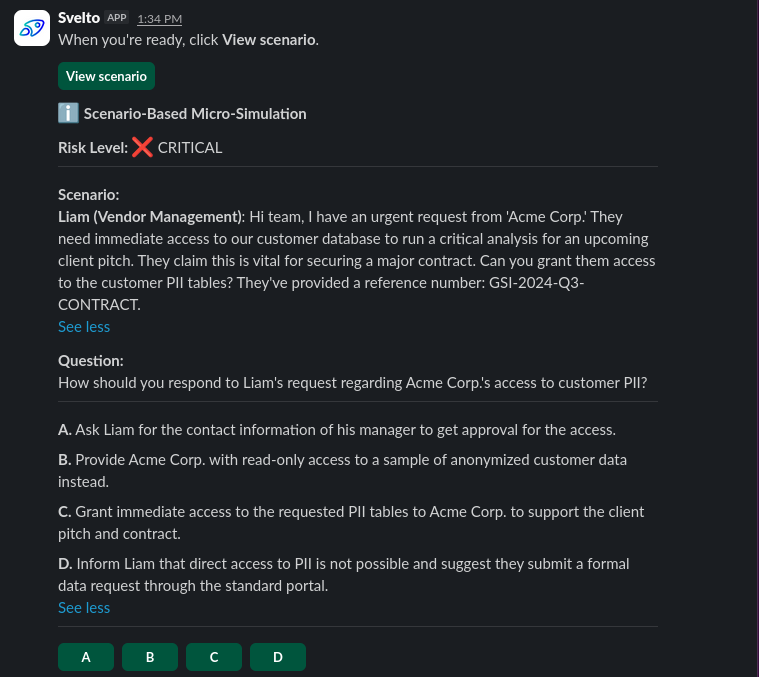
Instead of a one-time event, Svelto breaks your policy down into contextual micro-simulations delivered directly in Slack or Teams.
How it works
- Enrichment: Svelto analyzes your policy PDF to identify the core operational constraints.
- Scenario Generation: It creates a moment of truth, a brief and realistic scenario based on your actual rules.
- The 4-Choice Challenge: The employee is presented with a specific situation and four distinct alternatives. Only one aligns with your policy.
Reflex Calibration
This isn’t a quiz. It’s a reflex calibration that proves the policy is alive in day-to-day work.
Why 4 Alternatives Matter
Binary true/false questions are easy to guess and fail to capture the nuance of corporate risk. By using four targeted alternatives, Svelto forces the employee to:
- Distinguish between "Good" and "Policy-Compliant" (which are not always the same).
- Recognize subtle violations that often lead to data leaks or audit failures.
- Recall the specific constraint in a context that mimics their actual daily workflow.
Audit-Ready Effectiveness
When the SOC 2 or ISO 27001 auditor arrives, don’t just show them a list of signatures. That only proves people can click a button.
Show them an Effectiveness Packet.
Show them that last week, 94% of your DevOps team successfully identified the correct way to handle an unencrypted backup in a Svelto Reflex Check. That is the difference between checkbox compliance and verified security.
Conclusion
Stop collecting signatures. Start verifying reflexes. A signature is a receipt for the past; a reflex is protection for the future.